


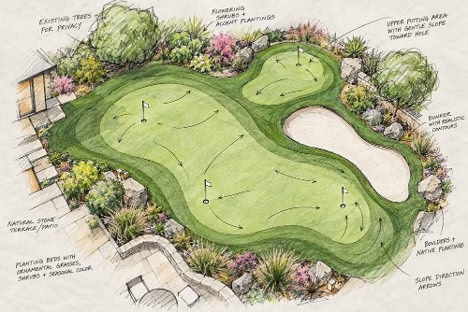
TL;DR: Learning how to design a putting green starts with understanding your property, golf goals, available space, and preferred style of play. Homeowners can bring valuable ideas to the process, but professional expertise helps turn those concepts into a putting green that drains properly, rolls consistently, and complements the surrounding landscape.
• Start by identifying the putting, chipping, and short game skills you want to practice.
• Plan contours, hole locations, putting distances, drainage, and turf selection carefully.
• Choose synthetic turf specifically engineered for realistic golf performance.
• Integrate the green with existing landscaping, patios, pools, and other backyard features.
• Work with a professional putting green designer to turn your ideas into a buildable, high-performing design.
A backyard putting green can turn unused outdoor space into a place to practice, entertain, and enjoy golf without leaving home. Before installation begins, though, you have to decide what that green should actually look like.
It can be tempting to design a putting green yourself. After all, you know your property, your golf game, and the features you want. Sketching ideas can be a great starting point, but translating those ideas into a golf green that performs properly requires more expertise than choosing a shape and deciding where the holes should go.
Here is what to consider before tackling your own putting green design and when it makes sense to bring in a professional.
Start With How You Want to Use the Green
The best design begins with your goals. A casual golfer may want an attractive green for entertaining and recreational putting. A serious player may want a demanding practice environment that can help improve the short game. Think about the shots you want to practice. Do you primarily want to putt? Would you like enough surrounding space for chips and pitches? Do you want multiple hole locations, bunkers, fringe, or different lies?
Answering these questions gives your putting green designer a much clearer picture of what the finished space needs to accomplish.
Consider Your Available Space
Some backyard putting green design ideas look incredible in photos but may not work on your property. Lot dimensions, slopes, existing landscaping, patios, pools, trees, and other structures all influence the final layout.
Bigger isn’t automatically better. A smaller green with intelligently designed contours can provide more useful practice than a larger surface without enough variation.
Good putting green designs for backyards work with the existing property instead of forcing a golf feature into an unsuitable location.
Think About Putting Distances and Hole Locations
If you’re going to design a putting green, think beyond its overall shape. Hole placement and putting distances determine how much variety the green provides. Multiple cups can create several practice lines from different locations. Thoughtful contours can make the same putt behave differently depending on your starting point.
Look at real golf courses for inspiration. Golf course architects use slopes, breaks, hazards, and sightlines to make players think about each shot. A residential green operates on a much smaller scale, but many of those same principles can make it more engaging.
Design with Natural Contours in Mind
One of the easiest mistakes in amateur putting green design is adding too much break.
Dramatic slopes may look interesting on a sketch, but excessive contours can make parts of the surface frustrating or impractical. You need enough movement to create challenging putts while retaining useful practice areas.
A professional putting green designer understands how grading and contours affect ball movement. That expertise can help produce breaks that feel more like those encountered on a quality course.
Synthetic Turf Changes the Design Process
Designing a synthetic turf putting green isn’t exactly the same as designing one made from natural grass.
Natural greens require careful consideration of mowing, irrigation, sunlight, soil, drainage, and ongoing turf management. Synthetic greens eliminate many of those maintenance requirements, but the underlying construction becomes critical to performance. The base must be properly prepared and shaped before the artificial grass is installed. Small inconsistencies underneath the turf can affect the finished surface and ball roll. That means your design has to account for much more than what will be visible after installation.
Build Drainage Into the Design
Drainage isn’t the most exciting part of creating a backyard green, but it can be one of the most important.
Water needs somewhere to go after rain or irrigation from surrounding landscaping. Poor planning can lead to drainage problems around the green or elsewhere on the property. An experienced putting green contractor can evaluate existing grades, soil conditions, drainage patterns, and surrounding landscaping before construction begins. Those findings may influence where the green should sit and how its base should be built.
Choose Turf Based on Performance
Not every synthetic turf product is designed for golf, and not every golf turf delivers the same playing characteristics. Putting surfaces need to provide consistent speed and realistic ball roll. If the design includes chipping areas, turf selection becomes even more important because the surface needs to respond appropriately to incoming shots. Celebrity Greens invests extensively in research, development, and testing to create exclusive golf turf products for its installations. Matching the right surface to the intended style of play is an important part of professional design.
Integrate the Green Into the Landscape
Your putting green doesn’t have to look like a patch of artificial grass dropped into the middle of the yard. Consider how the design connects with patios, pools, pathways, retaining walls, trees, and planting beds. Bunkers, rock features, landscape lighting, and different turf cuts can also help the green feel integrated into the overall property. Some of the most effective putting green designs for backyards function as both golf amenities and landscape features.
Recognize When Expert Design Adds Value
There’s nothing wrong with creating your own initial concept. In fact, homeowners should be actively involved in the design process. Sketch the shape you like. Identify features you want. Think about favorite holes from golf courses you’ve played. Decide which parts of your short game you want to practice most often. The challenge comes when that concept needs to become a buildable plan. A professional putting green contractor can evaluate grading, drainage, base construction, turf selection, contours, cup locations, and surrounding features. A skilled designer can then refine your ideas into a green that fits the property and performs correctly.
Work With a Putting Green Designer to Refine Your Vision
You can shape the vision for your green while working with professionals to bring the details together.
A collaborative approach often makes more sense. Bring your goals and backyard putting green design ideas to an experienced professional, then work together to refine them. You retain control over the vision while benefiting from technical knowledge gained through designing and building real greens.
Celebrity Greens creates custom backyard putting greens and private golf complexes designed around the property, and desired golf experience. From contours and turf selection to chipping areas, bunkers, and landscaping integration, every element can be planned to create a green that looks impressive and gives you a meaningful place to practice.
Your ideas should shape the project.
Professional design can help make sure those ideas play as good as they look.
Schedule and discuss the next steps to building your next putting green with Celebrity Greens, 888-507-7960.